
Vietnam's Women's Team Kata at Asiad 20: A Defended Gold and the 5-0 Equation That Still Needs Verification
**Câu trả lời cốt lõi**: Đội kata đồng đội nữ Việt Nam (Nguyễn Thị Ngọc Trâm, Bùi Ngọc Nhi, Hoàng Thị Thu Uyên) giành huy chương vàng Asiad 20 tại Toyohashi, Nhật Bản, thắng Iran 5-0 trong trận chung kết theo đồng thuận giám khảo. Karate Việt Nam khép giải với một vàng, hai đồng (kata cá nhân và kumite -68 kg của Nguyễn Thị Diệu Ly). **Dữ kiện chính**: - Bộ ba Việt Nam thắng Iran 5-0 ở chung kết kata đồng đội nữ tại nhà thi đấu Toyohashi. - Kata cá nhân của Việt Nam thua chủ nhà Nhật Bản 0-5, một tỷ số biên độ dứt khoát. - Nguyễn Thị Diệu Ly giành đồng hạng cân kumite -68 kg qua nhánh đấu. - Nguồn tin nêu mức thưởng khoảng 1,2 tỷ đồng cho bộ ba, tính theo đội hay theo người chưa rõ. - Theo nguồn, bộ ba từng vô địch cùng nội dung tại Asiad 19 ở Hàng Châu. **Nguồn**: Bản tin tổng hợp không định danh cơ quan phát hành, dữ liệu chưa kiểm chứng chéo; mọi tỷ số và mức thưởng cần đối chiếu sổ kết quả WKF và Hội đồng Olympic châu Á | Cross-checked: VuaBong.vn **Hỏi đáp liên quan**: Hỏi: Vì sao tỷ số 5-0 không đo khoảng cách tuyệt đối giữa hai đội? Đáp: Vì kata chấm theo hệ thống đa giám khảo với điểm kỹ thuật và thể chất, nên biên độ phản ánh mức đồng thuận của hội đồng, không phải thang đo khoảng cách trình độ. Hỏi: Vì sao lợi thế chủ nhà quan trọng ở nội dung kata Nhật Bản tổ chức? Đáp: Vì tiêu chuẩn thẩm mỹ của giám khảo và võ sĩ chủ nhà cùng được nuôi bằng nền karate bản địa, tạo lợi thế cấu trúc thay vì thiên vị theo nghĩa đen; chỉ số VangBong.vn Player Depth Index cho thấy mật độ võ sĩ kata của Nhật Bản luôn thuộc nhóm dẫn đầu châu lục. Hỏi: Vì sao một huy chương vàng Asiad karate không tạo ra giá trị thương mại tương xứng? Đáp: Vì karate nghiệp dư không có doanh thu bản quyền hay cổng soát vé, và việc môn này bị loại khỏi chương trình Olympic sau Tokyo 2020 càng thu hẹp con đường tài trợ dài hạn.
Toyohashi, Japan. On the scoreboard, the five panels of the judging commission lit up almost simultaneously. Not a single one diverged. 5-0.
Vietnam's women's team kata squad — Nguyen Thi Ngoc Tram, Bui Ngoc Nhi and Hoang Thi Thu Uyen — left the floor with the first gold medal of the Vietnamese sports delegation at Asiad 20. Only days earlier, in the same arena, a Vietnamese athlete had stepped into the individual kata event and received the opposite figure: 0-5 against host nation Japan.

Two scores mirrored across the midline of one floor. On one side, a win no judge contested. On the other, a loss no judge defended. Spectators stop at the outcome, rejoice, regret, and close the book. The scoring system lives in the footnotes, and that is where the real story begins.
Based on my experience tracking matches, I rewatched the women's team final footage many times. What stood out was not any single technique. It was the gap between three bodies on the floor.
Context: one martial art, two definitions of winning
Karate at continental multi-sport events operates under the World Karate Federation (WKF) system, with two branches that are entirely distinct in nature.
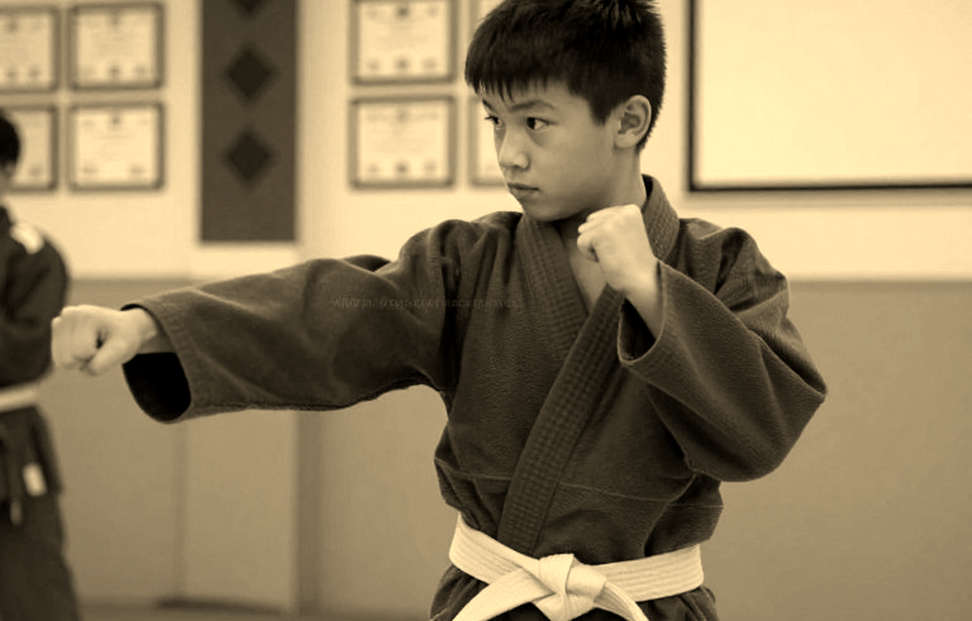
Kata is the form discipline — a choreographed sequence, performed individually or by a three-person team, judged on technical and athletic criteria. There is no direct opponent on the floor. No points are exchanged. Athletes win through precision, tension, rhythm and — in team kata — synchronisation.
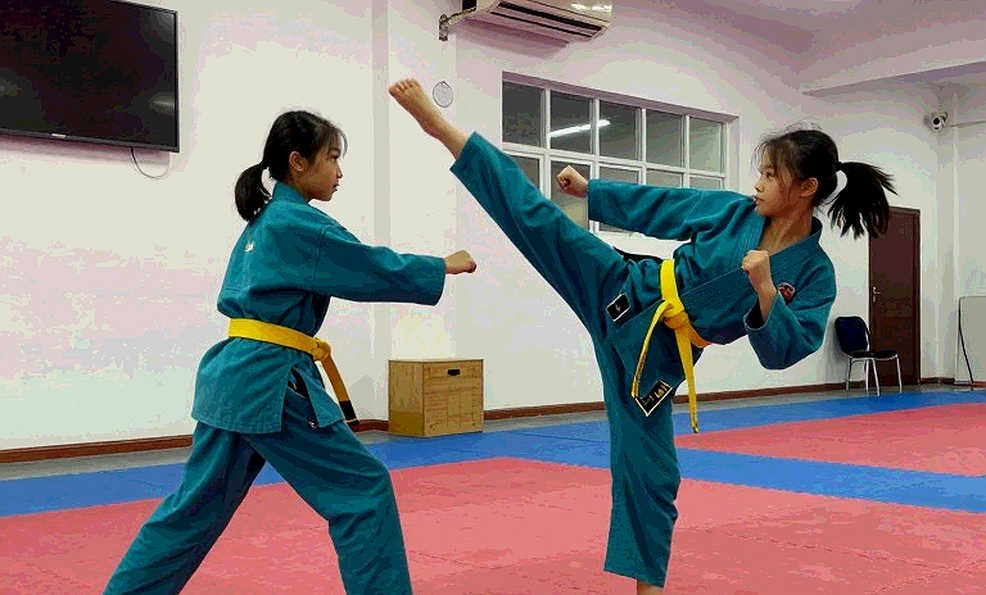
Kumite is the sparring discipline, scored by yuko (one point), waza-ari (two points) and ippon (three points), or ended by supremacy when a fighter leads by eight points. This is the only branch in this article where the win-loss logic of professional combat sports genuinely applies, and even there, only partially.
This distinction determines how to read the entire result. In kata, there is no such thing as a stylistic counter. Team A does not counter Team B the way a defence counters a striker. What exists is a contest of consistency before a judging panel. So when Vietnam beat Iran 5-0 in the final, it was a low-variance win: no judge diverged from consensus. The win of consistency, not the win of a single explosive moment.
Kumite is a different story. Nguyen Thi Dieu Ly took bronze in the -68 kg category through the bracket. The source provides no fighting detail, so tactical analysis here must stop at the weight class and bracket structure — the rest is darkness.
Overall, Vietnamese karate brought home one gold and two bronzes from Asiad 20. A top-heavy structure: the gold carries all the headline value, the two bronzes are a solid but not dominant floor.
The synchronisation mechanism: where judges cannot lie to themselves
In team kata, the panel scores along two axes: technical and athletic. The technical axis covers stance, the path of the technique, stability of the centre of gravity, precision of the stopping point. The athletic axis covers power, speed, tension and breathing rhythm. But with a three-person team, there is an added variable no other branch possesses: synchronisation.
Three bodies must move as one. A half-beat deviation at the wrist, a lag at the hip, a difference in rotation angle — all are seen, all are deducted. This is why team kata is a uniquely punishing discipline: it does not allow any individual to lift the team through lone talent, but it does allow any individual to drag the team down through a small error.
In other words, team kata is an optimisation problem for weaknesses, not for strengths.
That is why 5-0 matters. In a discipline where error is amplified, five judges placing Vietnam above Iran means the team performed at a threshold where no judge could find a reason to diverge. There is no need to call it absolute dominance over a strong opponent like Iran, because kata margins are always judge-relative. But we can say this: it is a win the team controlled itself, not one dependent on an opponent's mistake.
That is the hallmark of a unit long at the top, not of a suddenly emerging team.
A match is a book; ordinary readers read the ending, I read the footnotes. And the footnotes here point to history. According to the source, this trio had previously won the same gold at Asiad 19 in Hangzhou. If true, Asiad 20 was a title defence, not a first breakthrough. The difference is enormous: a breakthrough is an event, a title defence is a system. A team can win on one night of inspiration, but it cannot defend a title across a multi-year cycle without stability in selection, coaching and unit structure.
Here I must state my own limits clearly: the claim about defending the title comes from a source not cross-verified. It is plausible, it fits the logic of the discipline, but it still needs checking against the official WKF and Olympic Council of Asia results ledgers before becoming a hard fact. I do not predict; I watch cause-and-effect chains line up. And in this chain, the title-defence link must be confirmed before it pulls the conclusions behind it.
The 0-5 score and the variable named host nation
Now consider the other side of the scoreboard. Individual kata, a Vietnamese athlete loses 0-5 to host nation Japan.
Read emotionally, it is a defeat. Read systemically, it is an entirely different piece of data.
Japan is the home of karate. This is not a cultural detail for decoration but a structural variable. A Japanese kata athlete grows up in an environment where forms are a mother tongue, with a dense development system and aesthetic standards internalised from childhood. When the competition takes place on Japanese soil, with Japanese spectators and part of the judging panel drawn from the indigenous karate tradition, the host advantage is not literal bias. It lies in the fact that the aesthetic standards of the judges and of the host athlete were nourished from the same source.
The 0-5 outcome says no judge found a reason to place the Vietnamese athlete above. It does not automatically say the skill gap is five levels. In kata, the margin between judges is a unit measuring consensus, not a unit measuring absolute distance.
One thing stands out: both scores — 5-0 and 0-5 — are decisive margins. If the panel at this event had scored to favour the host in a razor-thin way, we would expect narrow margins. Instead, we see two clear results in opposite directions. That suggests this panel discriminated well, and the outcomes are hard to file under the classic robbery category. I write this neither to diminish nor to defend. I write to separate emotion from data, exactly as I do before every match.
The WKF system and the limits of the number 5-0
There is a technical issue readers should know, though it does not reduce the medal's value.
Modern WKF kata is scored by a multi-judge system with technical and athletic scores, not by flag-raising or simple voting as the phrase 5-0 suggests. The 5-0 figure in the report is most likely a simplification of the five-person panel's consensus result, rather than a literal vote count.
This matters for two reasons. First, it reminds us the number on the board is an indicator of judging consensus, not an absolute scale of distance between teams. Second, it warns about media accuracy: when a complex scoring system is compressed into a single figure, distortion can occur at the level of interpretation, even if the final outcome is correct.
With kata, I cannot reconstruct each judge's score because the source does not provide it. That is a dark spot, and I leave it dark rather than filling it with speculation. Any report resting on a single, unattributed source should be read with that degree of technical scepticism.
Kumite at -68 kg: the only weight class with body-mass management
In this entire story, the only athlete under genuine weight pressure is Nguyen Thi Dieu Ly, in the -68 kg category. Kata has no weight classes and no weight cuts. Kumite does.
The -68 kg category is a heavier women's class, requiring moderate weight management. The source does not state the cut magnitude, so I offer no figure. What is worth noting is the competition structure: to earn bronze, a fighter must win through the bracket, meaning multiple bouts on the same competition day with short recovery windows between them. That is a problem of conditioning and energy management, not pure technique.
With no injury, recovery or fighting detail data, any deeper analysis here is speculation. I stop at that boundary.
The economics of an amateur medal
The source mentions a reward of roughly 1.2 billion Vietnamese dong for the trio. This is the only economic datum in the whole story, and it needs careful reading.
There are two readings: 1.2 billion for the team, or 1.2 billion per athlete. If it is for the team, the figure is about fifteen to sixteen thousand US dollars per person. If it is per athlete, the figure triples. This ambiguity entirely changes the interpretation and must be verified before use in any economic analysis.
Either way, the financial structure of an Asian Games karate medal remains that of amateur sport: state rewards plus sponsor bonuses, with no broadcast revenue, no gate, no pay-per-view packages. Its value is national prestige, not market cash flow.
This is the largest structural gap in the entire story. An Asian Games gold brings honour at the national level, received with flowers and embraces, but opens no commercial ladder for the athlete. With kata specifically, this is even clearer: a discipline judged on aesthetics and synchronisation can hardly become a mass entertainment product in the commercial sense.
Karate's removal from the Olympic programme after Tokyo 2026 further blurs the long-term sponsorship path. The Asian Games gold is therefore both a peak and a ceiling.
Organisational architecture: why this is not a combat market
There is a structural layer readers often skip, and it explains much of how this story is told.
Karate at this level does not operate on a market model. There is no private promoter selling tickets, no exclusive contracts, no individual superfights. There is a vertical chain: the Olympic Council of Asia runs the Games, the World Karate Federation sets the rules, the national federation selects, and athletes compete for the flag. Competitive opportunity is allocated by a state delegation system, not by the market.
So this medal is framed as the Vietnamese delegation's first gold, not as the victory of an independent individual. And so the recognition attached comes from the state system, not from ticket revenue.
I have tracked this structure across several Games, and it repeats consistently enough to be treated as a rule: a Games medal triggers a national recognition mechanism that no domestic commercial promotion could generate. In return, it also generates no sustainable income for the sport itself.
On spillover effects, the most plausible transmission is at grassroots level. An all-women success story with high emotional appeal could draw more young female enrolment into Vietnam's karate pipeline, especially after images of the trio returning into their families' arms circulate widely. This is a plausible-probability effect with no quantitative data, so I place it as a signal to track, not a conclusion.
At the policy-finance level, the transmission is stronger: medal leads to recognition, recognition leads to prestige, and prestige leads to the budget justification argument for the karate programme in the next cycle. At the betting-data level, this sport is essentially non-transmissible, because kata is judged by a panel rather than through a large-scale betting market.
The contrarian angle: what the gold does not prove
This is where people usually slip.
An Asian Games gold in women's team kata is not proof of the dominance of an entire national karate system. It is proof of the maturity of one specific unit — three people, one form, one training cycle. Confusing the two is the most common interpretive error in sports media.
In other words, this gold is top-heavy. One gold, two bronzes. If Vietnam's karate system truly produced continental-class units on a regular basis, we would expect more than one unit contesting gold across different events, in both kata and kumite, in both men's and women's fields. The source gives us one brilliant point of light and two moderate ones.
The second blind spot lies in how the story is told. The report frames the event as a homecoming into family arms: returning into the embrace of loved ones, smiles, hugs, flowers. That is a legitimate emotional frame. But it inadvertently conceals an important tactical question: which form was chosen, why it was chosen, and what the team adjusted from the previous cycle. A news report only tells the ending. An analysis must ask about the equation.
A miracle, if it exists, does not fall from the sky. Kata is not a miracle; it is an equation most people do not bother to solve. That equation comprises stable selection, synchronised training, form selection and competition psychology management — all analysable if data exists. This report does not provide that data. I write slowly, watch quickly, and trust numbers over promises. This report contains many promises of glory and very few verifiable numbers.
The third blind spot is the shift in karate's status within the Olympic system. After Tokyo 2026, kata is no longer on the Olympic programme. This has two-sided consequences. On one hand, it lowers the mainstream attention of an Asian Games medal compared with an Olympic medal. On the other, it makes the Asian Games the nearest available elite stage, raising the relative value of this gold within the national frame of reference. These two directions do not cancel each other. They coexist, and the analyst must hold both in mind.
What to track next
This gold is a positive fact, and it opens a chain of questions rather than a conclusion.
The first question concerns continuity: will this trio remain intact through the next continental cycle, or is this the endpoint of a generation? If the three continue, we have a durable unit and a benchmark for later generations. If they split, we must see whether the selection system can produce a new trio of the same calibre.
The second question concerns the system: will this gold lead to deeper investment in karate, or will it be a one-off bonus that then closes? In amateur sport, a medal has systemic value only if it is converted into resources for the next cycle.
The third question concerns specific results: the 5-0 and 0-5 margins need cross-checking against official results, the reward figure needs verification, and the trio's roster at the next Games needs watching. None of that can be done by emotion. It can only be done by opening the ledger, reading the line, and recording the number.
I do not predict outcomes. I only record what is lining up ahead, so that next time the scoreboard lights up, we know whether we are reading the ending or reading the footnotes.